Enquire Now



Enquire Now
 Published: April 30, 2026
Last Updated: July 16, 2026
Published: April 30, 2026
Last Updated: July 16, 2026
A water heater plays a vital role in daily comfort. But just like any other home appliance, it does not last forever. Initially, repairs can be the most appropriate choice. However, in the long run, repeated repairs may be more expensive than a complete replacement. Thus, being aware of when to repair and when to replace can save money, time, and stress.
The majority of traditional water heaters have a lifespan of 8-12 years. Tankless systems have a longer lifespan. But age is not the whole story. Also influenced are usage patterns, water quality, and maintenance.
An example is mineral deposition, which can be caused by hard water. This makes the heater work harder and wear out sooner. In addition, the lack of proper maintenance accelerates internal damage. Thus, a younger unit can break down even earlier than anticipated.
Small repairs initially are not harmful. But persistent problems portend greater ills.
Be aware of the following danger cues:
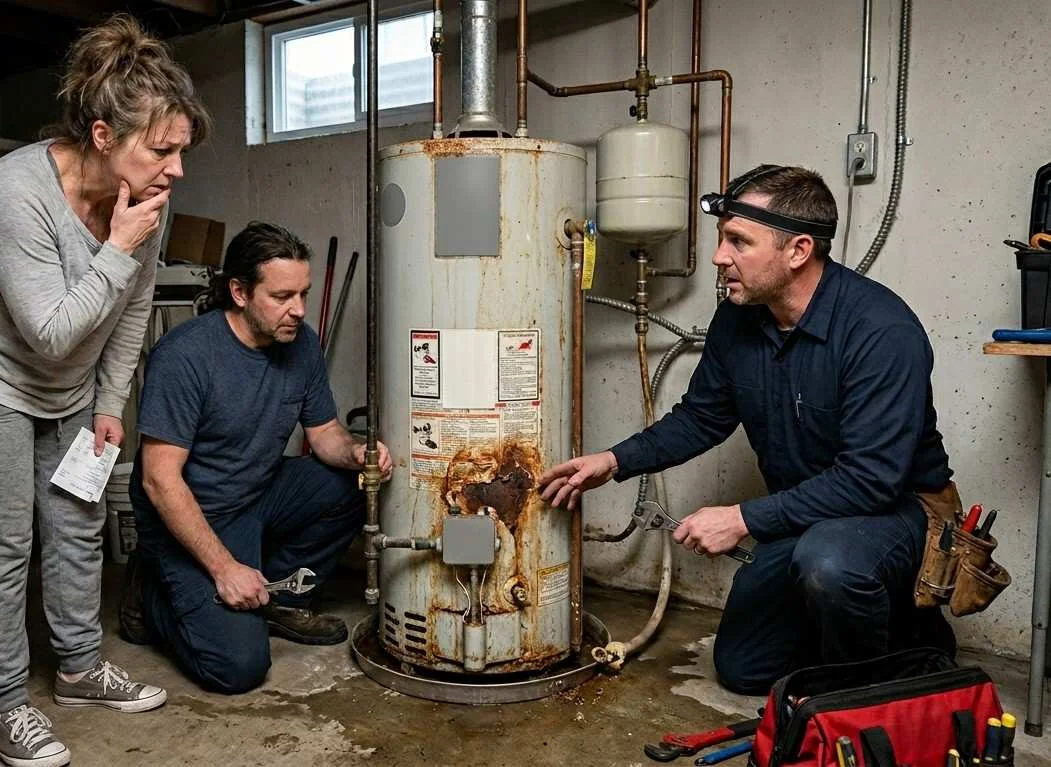
In addition, internal failure is likely due to leaks around the tank. Repairs in such situations often do not yield long-term results. They are instead just stopgap solutions.
Fast repair, replacement & installation by licensed experts. Same-day service.
The first one has a lower repair cost. Nevertheless, several repairs are expensive. For example, over time, it is costly to repair heating elements, thermostats, and valves.
There is a simple rule that aids. When the cost of repair exceeds half the cost of a new unit, it is better to replace. Moreover, older units are inefficient. Consequently, they use more energy and raise their monthly bills.
Newer models, on the other hand, are more energy efficient. Hence, replacing your heater can save you a lot of money on utility bills in the long run.
The new water heaters are technologically advanced. Consequently, they warm water more quickly and consume less energy. This has a direct reduction in electricity or gas bills. Moreover, energy-saving models are less harmful to the environment. Thus, homeowners save money while promoting sustainability.
For example, tankless systems heat water as needed. Consequently, they eliminate standby heat loss. As a result, they consume less energy compared to conventional tanks.
Safety should be first. Older water heaters may be very dangerous. For example, gas leakage or pressure accumulation may cause dangerous situations. In addition, tanks can burst unpredictably due to rusting. This problem may lead to water damage and expensive repairs. So, it will be more prudent to substitute a hazardous unit.
Secondly, old systems might not meet current safety standards. Modernizing will enhance the security of your home and family.
The aging water heater is usually unable to keep pace with the day-to-day demands. One example is that hot water can be exhausted easily. This issue is exasperating, particularly when dealing with larger families.
In addition, irregular temperatures impact day-to-day activities. Showering is unpleasant, and washing is time-consuming. In comparison, a new system provides stable performance. Thus, you have hot water, which is dependable and available whenever you need it.
There are cases where age and repair frequency overlap. For example, a 10-year-old heater that requires frequent repairs is a strong indicator that it should be replaced. Also, older components are more difficult to locate. This results in longer, more expensive repairs. Hence, it becomes viable to invest in a new unit.
At this point, further repairs will simply postpone the imminent. Rather, replacement provides a long-term solution.

Once you have decided to replace it, it is important to choose the appropriate system.
Consider these factors:
Tankless systems fit in smaller areas and give an unlimited supply of hot water. Storage tanks, on the other hand, can be used in large families with high demand. Further, having professional advice guarantees the correct decision. Professionals will be able to examine your needs and prescribe the most appropriate.
Although some homeowners are trying to fix it themselves, expert assistance is safe and efficient. Experienced technicians detect silent problems and provide appropriate remedies. At this stage, coordination with such professionals as Magnificent Plumbing & Rooter is guaranteed to smooth the transition. Their group assesses your existing system and suggests economical options.
Moreover, professional installation enhances performance and increases lifespan. Thus, you prevent future problems and have peace of mind.
First, replacement can be costly. Nevertheless, it is cost-effective in the long run. Reduced energy costs, fewer repairs, and greater efficiency are important value-adds. Also, most of the modern systems are warranted. This leaves you with the added benefit of additional safeguards against unforeseen problems. Replacing your water heater will, then, be a smart investment, not a liability.
The choice between repair and replacement may be tough. But certain indications simplify the choice. Repeated fixing, escalating expenses, and decreased performance are all indications of replacement. In addition, recent systems are more efficient, safer, and comfortable. Thus, the replacement is a better investment that enhances your day-to-day life and saves costs in the long run.
When your unit is exhibiting these alert signs, do not delay. Get in touch with Magnificent Plumbing & Rooter to get quality services and professional guidance.
