Enquire Now


Enquire Now
 Published: April 17, 2026
Last Updated: July 16, 2026
Published: April 17, 2026
Last Updated: July 16, 2026
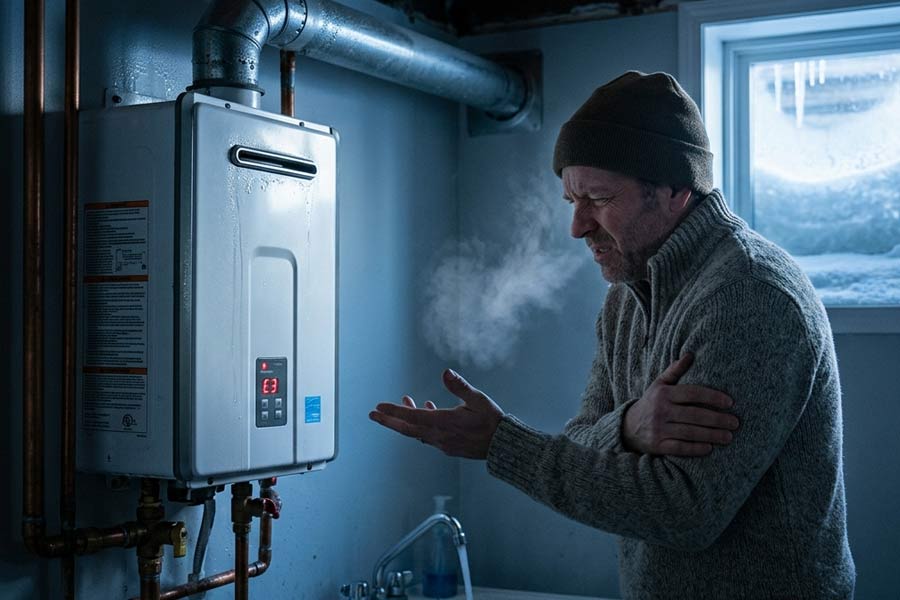
Tankless water heaters have become popular due to their space-saving design and efficiency. But there is one question that most homeowners pose. Do they struggle during cold winter months? The answer is NO, but the performance is based on several factors. Thus, being aware of the work of these systems during winter will prevent surprise.
Tankless systems warm the water when required. They do not store hot water in a tank. Instead, they employ strong heating devices or gas burners. Water passing through the unit is heated immediately. This leaves you with an unlimited supply of hot water.
But winter alters the temperature of incoming water. Groundwater becomes much colder. This means that the heater will have to strain more to achieve the required temperature.
Suppose you need 120 F water, the system will have to increase the temperature more in winter. So, performance is conditioned by the capacity of the unit.
Tankless water heaters do not “struggle” in the traditional sense. They can, however, be limited. They normally come at a time when there is high demand and low capacity.
An example of this is having multiple fixtures running simultaneously, and this can lower the water temperature. On the same note, bigger households might observe changes. Nevertheless, such a problem does not imply failure. Rather, it demonstrates the necessity of the appropriate sizing and installation.
There are a number of variables depending on the performance of your system during cold weather.
A well-sized unit will achieve better winter requirements. Nevertheless, small units cannot be as good as expected. Hence, it is always advisable to select a system depending on your needs in the house.
Colder climates generate greater temperature variations. This means that heaters have to work harder. This factor directly impacts output.
Demand with high flow may decrease heating efficiency. An example is that the simultaneous use of showers and washing machines can overload the system.
Gas-powered units tend to work well in extreme cold. Conversely, electric units might not be good with extreme temperature increases.
Luckily, there are simple things you can do to make sure that you perform well in winter.
The adequate installation is important. Even the finest unit will not work when fitted improperly. Thus, cooperation with professionals will guarantee maximum performance.
Most homeowners at this stage resort to the services of reputable experts such as Magnificent Plumbing and Rooter. They are qualified to do the right sizing and installation. This means that your system works reasonably well even in winter.
Nevertheless, tankless systems have a number of winter benefits.
Most individuals assume that tankless heaters do not perform during winter. This is, however, not true. There is another myth that they are not able to cope with cold weather. As a matter of fact, contemporary units are created to meet different conditions. Thus, it is set up rather than the climate.
In case your system is not able to keep up, you can upgrade. Symptoms are irregular temperatures and poor circulation. Also, frequent usage problems reflect capacity problems.
In this situation, the services of professionals come in handy. Professionals such as Magnificent Plumbing & Rooter can evaluate your needs. They suggest the most appropriate option for your house.
In winter, tankless water heaters do not necessarily have troubles. Nonetheless, performance is dependent on correct sizing, installation, and usage. The cold weather brings demand, and modern systems can cope with it.
So, understanding your system ensures better results. Proper installation enables you to have a consistent supply of hot water throughout the year. Professional guidance is also important to invest in. Magnificent Plumbing & Rooter offers the skills that can ensure the best performance.